

Research
The San Antonio Orthopaedic Journal
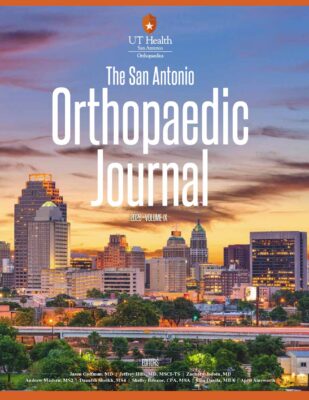
Browse the latest volume featuring resident and faculty research from across our department.
Message from the Vice Chair of Research
Lawrence Lavery, DPM, MPH
It is with great pleasure that I share the accomplishments of our research division over the past year. The calendar year 2025 has been a highly productive one for our department, marked by significant growth in both scholarship and collaboration.
Our faculty, residents, and students collectively published approximately 60 peer-reviewed manuscripts indexed in PubMed. Numbers alone, however, do not capture the depth of this work. Many of these studies appeared in leading orthopaedic journals and highlight the broad range of clinical and scientific questions we continue to pursue. These achievements reflect the strength of our research culture and the dedication of our teams.
Looking ahead, we are committed to further expanding our clinical and basic science research programs. Building partnerships—within UT, with colleagues at outside institutions, and with industry collaborators—will be key to this effort. We will also continue to pursue competitive funding from federal agencies, foundations, and industry to support this growth.
Most importantly, we recognize that research is central to training the next generation of orthopaedic surgeons. Providing opportunities for residents and medical students to engage in high-impact projects remains one of our highest priorities. To that end, we have implemented a structured research curriculum for residents and launched an orthopaedic research fellowship for medical students interested in academic careers. These initiatives strengthen our ability to support and mentor future leaders in orthopaedic research.
We are proud of the accomplishments made in 2025 and optimistic about the years ahead. Research is never a solitary pursuit—it thrives through collaboration, mentorship, and shared commitment. I am deeply grateful to our colleagues, supporters, and sponsors for making this work possible.
Why We Promote Resident Research
As part of our mission, the Department of Orthopedics strives to improve lives through excellence in education and research in musculoskeletal disease. Research is a vital part of training the next generation of orthopedic surgeons at the University of Texas at San Antonio, UT San Antonio, teaching residents how to generate new knowledge and apply it to patient care. Participation during residency equips our graduates to become stronger clinicians and surgeons.
Facilities, Cores, Centers
Residents have access to facilities that support both clinical and basic science projects, including a state-of-the-art orthopedic laboratory, office space, meeting rooms, and a dedicated orthopedic library. All spaces are equipped with modern technology and computer access, along with seamless access to online libraries and clinical databases.