

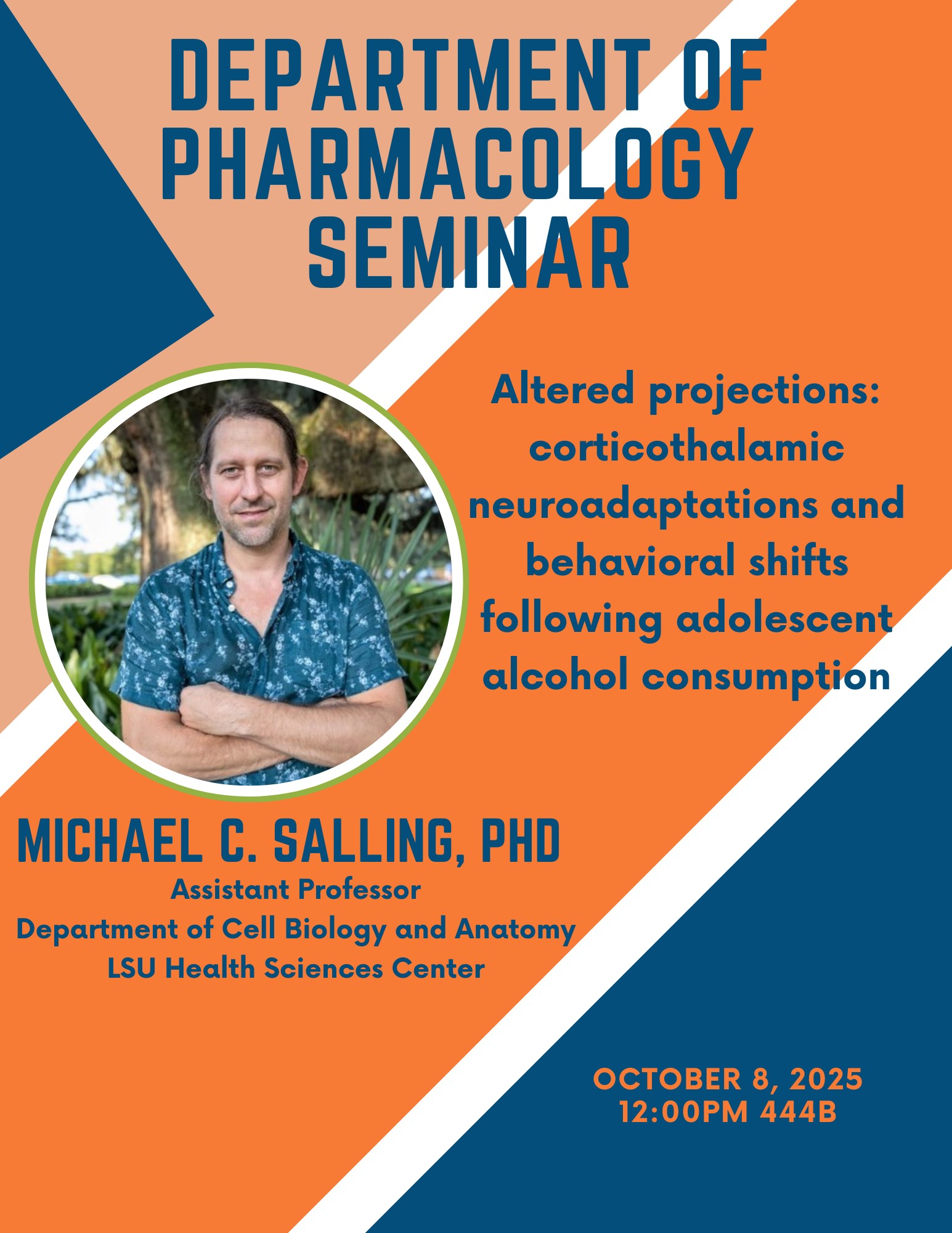
Seminar – Michael C. Salling, Ph.D.
Event Date & Time
October 8, 2025 at 12 NoonLocation
444B (LSOM)Event Details:
DEPARTMENT OF PHARMACOLOGY
SEMINAR SERIES
Wednesday, October 8, 2025
12:00pm – 444B MED
Michael C. Salling, Ph.D.
Assistant Professor
Department of Cell Biology and Anatomy
LSU Health Science Center
New Orleans, Louisiana
About the Speaker(s)
 The purpose of our lab is to better understand the consequences of drugs of abuse on neuronal function and how that might affect cognition and future drug abuse.
Frontal cortex function
The frontal cortex has a prominent role in the organization of behavior and is predictably well positioned to communicate rapidly and bidirectionally with vast arrays of cortical and subcortical networks. These signals are both phasic and rhythmic and can be expedited or stalled through local and distal neuromodulation; all triggered by what an animal is experiencing, what it has experienced, and its intrinsic circadian states of being. Our goal here is to deconstruct the complexity of the frontal cortex through 1.) hypothesis driven interrogation of the major frontal cortex inputs and outputs in the context of physiology or behavior 2.) activity-dependent labelling approaches to identify and characterize neurons that are active during discrete behaviors or following pharmacological modulation of neurotransmitter systems with drugs of abuse.
Adolescent alcohol and drug use
Most drug and alcohol use begins in adolescence, a time when the frontal cortex is still undergoing maturation. Alcohol and drugs taken in high quantities during this time may negatively affect frontal cortex development and contribute to poor decision making related to drug use in later life.To investigate this problem, we provide adolescent mice intermittent access to alcohol and assess the long-term behavioral consequences of binge-like alcohol consumption on learning and memory, anxiety, and decision-making in adulthood. Using ex vivo and in vivo techniques, we measure neuronal activity in the prefrontal cortex following alcohol exposure and during drug self-administration in an effort to determine if there are drug induced neuroadaptations that may underlie maladaptive, drug-seeking behavior.
Alcohol and HIV
Neurocognitive disorders are prevalent in individuals infected with human immunodeficiency virus (HIV associated neurocognitive disorder or HAND) and co-occurring alcohol use disorders (AUDs) can exacerbate these symptoms. HAND can include deficits in attention, memory, and executive function which can negatively affect the treatment compliance and disease progression of HIV and AUD. A better understanding of the underlying neurobiology may reveal additional therapeutic interventions for alcohol and HIV associated cognitive dysfunction. Utilizing nonhuman primate models developed and provided by the Comprehensive Alcohol-HIV/AIDs Research Center at LSUHSC, we investigate proposed mechanisms of brain dysfunction caused by SIV and chronic binge alcohol. We accomplish this using whole cell patch-clamp electrophysiology recordings and morphological reconstruction of neurons from brain slices collected from areas of the frontal cortex involved in the symptoms of HAND and hyperalgesia including the dorsolateral prefrontal cortex and anterior cingulate cortex.