

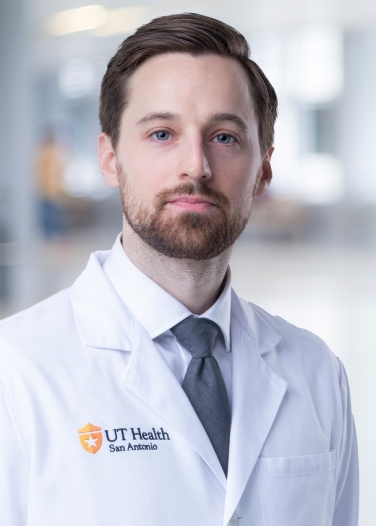
Kevin B. Koronowski, Ph.D.
Assistant Professor
Ph.D. in Integrated Biomedical Sciences
Biochemical Mechanisms in Medicine
Biology of Aging
Personal Statement:
Visit Dr. Koronowski’s Lab website
Koronowski Lab Expertise:
Circadian Rhythms; Circadian Clock, Metabolism and Metabolic Disease, Molecular Biology, Genetic Mouse Models
Laboratory projects aim to better our understanding of how metabolism is regulated across time (over the course of a day) and space (between cells and organs of the body). Acquiring this knowledge will help identify root causes of, and potential therapies for, metabolic diseases such as obesity, metabolic syndrome, type 2 diabetes and cancer. We model metabolic health and disease in cultured cells and mice using environmental, dietary and genetic tools that disrupt the circadian clock, a biological system tied to metabolic health. We employ cutting-edge techniques in metabolomics, molecular biology and in vivo metabolism.
Related Diseases: Circadian Rhythm Disruption, Obesity, Type 2 diabetes, Metabolic syndrome
Techniques: Light- and food-based circadian entrainment, clock knockout and reconstitution mouse models, behavioral assays, cellular bioenergetics, live cell imaging and luciferase reporters, cell conditioned media and co-cultures, RNA sequencing and real-time quantitative PCR, chromatin-immunoprecipitation, LC-MS metabolomics, substrate tolerance tests, others
Education
Education:
2017 - Ph.D. - Neuroscience - University of Miami
2012 - B.S. - Clinical Dietetics and Nutrition - University of Pittsburgh
Training:
2017 - Postdoctoral Fellowship - P. Sassone-Corsi Laboratory - University of California Irvine
Appointments:
2022 - Assistant Professor - University of Texas Health San Antonio
Research
Grants
Grantome
Publications
Koronowski KB*, Kinouchi K*, Welz PS*, Smith JG, Zinna VM, Shi J, Samad M, Chen S, Magnan CN, Kinchen JM, Li W, Baldi P, Benitah SA, Sassone-Corsi P. Defining the Independence of the Liver Circadian Clock. Cell. 2019 May 30;177(6):1448-1462.e14. PMID: 31150621. *Co-first author
Koronowski KB, Sassone-Corsi P. Communicating clocks shape circadian homeostasis. Science. 2021 Feb 12;371(6530):eabd0951. PMID: 33574181
Koronowski KB*, Greco CM*, Huang H, Kim JK, Fribourgh JL, Crosby P, Mathur L, Ren X, Partch CL, Jang C, Qiao F, Zhao Y, Sassone-Corsi P. Ketogenesis impact on liver metabolism revealed by proteomics of lysine b-hydroxybutyrylation. Cell Reports. 2021 Aug 3;36(5):109487. doi: 10.1016/j.celrep.2021.109487. PMID: 34348140. *Co-first author
Greco CM*, Koronowski KB*, Smith JG*, Shi J, Kunderfranco P, Carriero R, Chen S, Samad M, Welz PS, Zinna VM, Mortimer T, Chun SK, Shimaji K, Sato T, Petrus P, Kumar A, Vaca-Dempere M, Deryagian O, Van C, Kuhn JMM, Lutter D, Seldin MM, Masri S, Li W, Baldi P, Dyar KA, Munoz-Canoves P, Benitah SA, Sassone-Corsi P. Integration of feeding behavior by the liver circadian clock reveals network dependency of metabolic rhythms. Science Advances. PMID: 34550736. *Co-first author
Mortimer T, Welz PS, Benitah SA, Koronowski KB. Collecting mouse livers for transcriptome analysis of daily rhythms. STAR Protocols. 2021 May 14;2(2):100539. doi: 10.1016/j.xpro.2021.100539. PMID: 34036284
Welz PS, Zinna VM, Symeonidi A, Koronowski KB, Kinouchi K, Smith JG, Guillén IM, Castellanos A, Furrow S, Aragón F, Crainiciuc G, Prats N, Caballero JM, Hidalgo A, Sassone-Corsi P, Benitah SA. BMAL1-Driven Tissue Clocks Respond Independently to Light to Maintain Homeostasis. Cell. 2019 May 30;177(6):1436-1447.e12. PMID: 31150620
Greco CM, Cervantes M, Fustin JM, Ito K, Ceglia N, Samad M, Shi J, Koronowski KB, Forne I, Ranjit S, Gaucher J, Kinouchi K, Kojima R, Gratton E, Li W, Baldi P, Imhof A, Okamura H, Sassone-Corsi P. S-adenosyl-l-homocysteine hydrolase links methionine metabolism to the circadian clock and chromatin remodeling. Science Advances. 2020 Dec 16;6(51):eabc5629. doi: 10.1126/sciadv.abc5629. PMID: 33328229
Koronowski KB, Khoury N, Saul I, Loris ZB, Cohan CH, Stradecki-Cohan HM, Dave KR, Young JI, Perez-Pinzon MA. Neuronal SIRT1 (Silent Information Regulator 2 Homologue 1) Regulates Glycolysis and Mediates Resveratrol-Induced Ischemic Tolerance. Stroke. 2017 Nov;48(11):3117-3125. PMID: 29018134
Koronowski KB, Dave KR, Saul I, Camarena V, Thompson JW, Neumann JT, Young JI, Perez-Pinzon MA. Resveratrol Preconditioning Induces a Novel Extended Window of Ischemic Tolerance in the Mouse Brain. Stroke. 2015 Aug;46(8):2293-8. PMID: 26159789
Koronowski KB, Khoury N, Morris-Blanco KC, Stradecki-Cohan HM, Garrett TJ, Perez-Pinzon MA. Metabolomics Based Identification of SIRT5 and Protein Kinase C Epsilon Regulated Pathways in Brain. Front Neurosci. 2018 Jan 30;12:32. doi: 10.3389/fnins.2018.00032. PMID: 29440987
A full list at My Bibliography – https://www.ncbi.nlm.nih.gov/myncbi/kevin.koronowski.1/bibliography/public/