HALO Procedural Refresher
Master the Critical Interventions You Rarely See,
But Must Perfectly Execute.
HALO Procedural Refresher: An intensive hands-on clinical training experience for Regional Emergency Medicine Physicians. Learn from nationally recognized experts.
Course is capped at 25 participants to ensure a ratio of 5-6 learners per faculty. Procedures will be taught at stations that learners will rotate through divided into morning and afternoon sessions. Scroll down below to view the course learning objectives and agenda.
“Amazing sim lab. Highly knowledgeable staff with well thought-out and run stations. It was focused on high yield, pertinent information. Appropriate amount of time allocated for each station. – 2025 Cohort Participant
Date & Time
Sept 22nd, 2026
8:30am-4:30pm
Course Fee
$600
Location
San Antonio, TX
Accreditation
CME Course
Location & Logistics
UT Health San Antonio
7703 Floyd Curl Drive 4th Floor, Room 418L San Antonio, TX 78229
✓ Catering: Complimentary premium breakfast and lunch are provided for all attendees.
✓ Parking Validation: Full campus parking fees are completely validated on-site.
Registration Details
Registration is restricted exclusively to regional practicing Emergency Medicine Physicians. Space is strictly capped to guarantee optimal instructor attention at each task-trainer hub.
Course Fee: $600
Deadline: September 8th, 2026
Deadline extended through Tuesday September 15, 2026!
Hands-On Training Modules
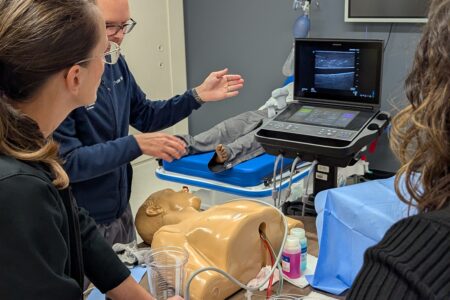
Airway & Surgical Procedures
Direct and video laryngoscopy
Fiberoptic intubation
Surgical cricothyroidotomy
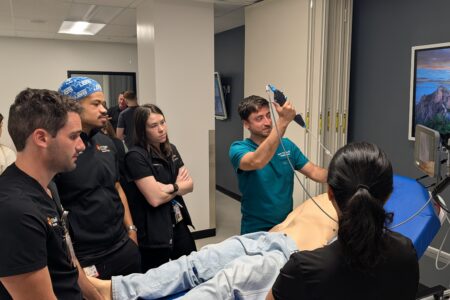
Vascular Access & Resuscitative
Thoracostomy & surgical escharotomy
Emergency pericardiocentesis
Subclavian central lines
Blakemore tube placement
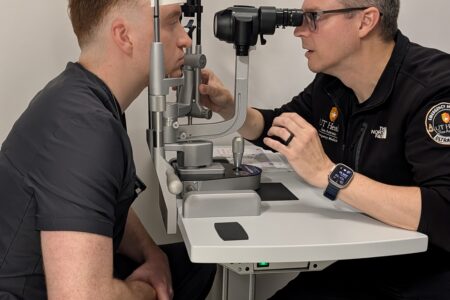
Emergency Ophthalmology
Slit lamp use & Ocular ultrasonography
Emergent lateral cantholysis
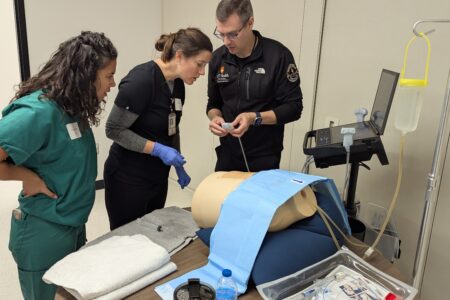
Specialized Simulation
Post-partum hemorrhage simulation
Acute resuscitation of the newborn
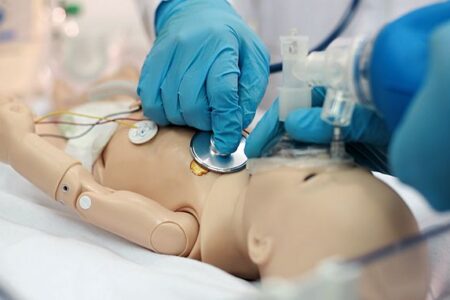
Critical Pediatric
Pediatric intubation (direct, all ages)
Pediatric lumbar punctures
8:30am-9:00am Breakfast and Orientation
- Outlining learning goals and objectives for this course
- Brief discussion of procedures to be covered
- Dividing learners into groups (4-5 learners for each station).
9:00am-12:00pm – Morning Stations (45 min/station)
| Station 1 | Station 2 | Station 3 | Station 4 |
Airway Carlson |
Resus Procedures 1 Solis |
Resus Procedures 2 Foster |
Pedi Perspective Kandhal |
| Laryngoscopy (direct and video) | Cricothyroidotomy | Pericardiocentesis | Pediatric LPs |
| Fiberoptic
Review of RSI Lit |
Thoracostomy | Subclavian Central Lines | Pediatric Airway Management |
| Slit Lamp Practice | Escharotomy | Blakemore | Review of Pedi RSI Literature |
12:00pm-1:00pm – Lunch
1:00pm-4:00pm – Afternoon Stations (45 min/station)
| Station 1 | Station 2 | Station 3 | Station 4 |
| PPH Sim
Solis |
NRP Sim
Kandhal |
Ocular Focus
Carlson |
Bonus Review
Foster |
| Maternal PPH Case
-Vaginal Delivery |
Newborn Resuscitation
– NRP Review |
Lateral Canthotomy | To be selected by participants |
| – Post-partum hemorrhage | – Pedi Airway | Slit Lamp Practice | |
| – Maternal Resuscitation | – Umbilical Cannulation | Ocular Ultrasound |
4:00-4:30pm – Wrap-up & Farewell
Learning Objectives by Station:
Morning Station 1: Airway
For the following listed procedures, at the completion of this educational session, learners/participants will be able to:
- Describe the clinical indication, risks, and benefits of performing laryngoscopy, endotracheal intubation, and use of fiberoptics.
- List harms and common complications of performing laryngoscopy, endotracheal intubation, and use of fiberoptics.
- Demonstrate successful performance of laryngoscopy, endotracheal intubation, and use of fiberoptics.
- Teach their colleagues, or others, about the current literature concerning intubation techniques, and preferred RSI medications.
Morning Station 2: Resuscitative Procedures 1
- Describe the clinical indication, risks, and benefits of performing cricothyroidotomy, thoracostomy, and escharotomy.
- List harms and common complications of performing cricothyroidotomy, thoracostomy, and escharotomy.
- Demonstrate successful performance of cricothyroidotomy, thoracostomy, and escharotomy.
Morning Station 3: Resuscitative Procedures 2
- Describe the clinical indication, risks, and benefits of performing Blakemore tube placement, subclavian central line cannulation and pericardiocentesis.
- List harms and common complications of performing Blakemore tube placement, subclavian central line cannulation and pericardiocentesis.
- Demonstrate successful performance of performing Blakemore tube placement, subclavian central line cannulation and pericardiocentesis.
Morning Station 4: Pedi Perspectives
- Describe the clinical indication, risks, and benefits of performing pediatric lumbar punctures, and pediatric intubations.
- List harms and common complications of performing pediatric lumbar punctures, and pediatric intubations.
- Demonstrate successful performance of pediatric lumbar punctures, and pediatric intubations.
- Teach their colleagues, or others, about the current literature concerning intubation techniques in children, and preferred RSI medications.
Afternoon Station 1: Post-partum hemorrhage sim
- Demonstrate resuscitation of a patient suffering from post-partum hemorrhage
- Describe medications and techniques integral to resuscitating a patient with post-partum hemorrhage
- Demonstrate how to perform uncomplicated delivery of a newborn
Afternoon Station 2: Neonatal resuscitation sim
- Demonstrate resuscitation of a newborn patient requiring resuscitation
- Discuss and demonstrate appropriate oxygenation, and airway management of a newborn, including suctioning, supplemental oxygenation, and intubation
- Demonstrate successful performance of umbilical cannulation, and endotracheal intubation of a newborn
Afternoon Station 3: Ocular focus
- Describe the clinical indication, risks, and benefits of performing lateral canthotomy, and performing slit lamp examinations.
- List harms and common complications of performing lateral canthotomy.
- Demonstrate successful performance of lateral canthotomy.
- Describe how to use a slit lamp and an ultrasound to examine the eye.
- Describe how to identify pathology of the eye using ultrasound and slit lamps.
Afternoon Station 4: Bonus Review
Adult Learning Model: Learners will, as a group, select procedures from the morning that they would like to get additional time practicing and additional time will be spent reviewing them.
Advance Your Emergency Readiness
Ensure crisp performance when facing rare, high-stakes medical crises. Join us at the UT San Antonio Simulation Center. Register below!