

Training Sites
Training Sites
Below are the details of the main rotation sites for the fellowship program. This list does not include elective opportunities in San Antonio as those sites are considered optional rotations and would vary based on the fellow’s interests.
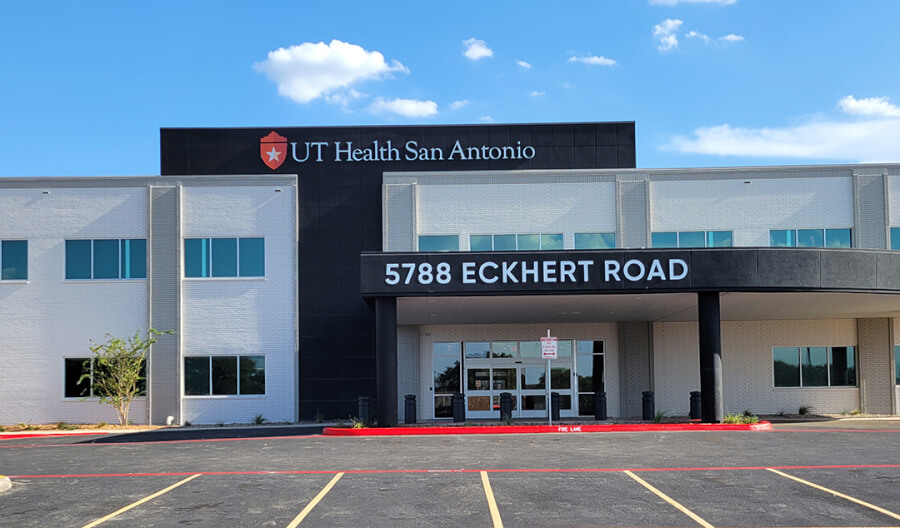
UT Health San Antonio is the sponsoring institution and the program’s home base. The Psychiatry campus is also an active rotation site, where fellows conduct court-ordered evaluations on Mondays.
Mondays are court-ordered evaluations, with individual preceptorship built in.
Tuesdays are the academic day. Fellows participate in supplemental didactics across the breadth of forensic topics, group case rounds, and a landmark forensic cases covering the decisions that define the field. Every fellow receives one protected hour of one-on-one supervision per week, and adjusted to the fellow’s caseload. Protected time is reserved for scholarly and quality improvement work.
Friday mornings connect fellows to the state. Fellows attend virtual Texas-wide didactics, journal club, case rounds and mock trials. Our fellow will join other forensic fellows and faculty from programs across Texas. Few fellowships can offer a peer network beyond their own walls. Ours is built in.
Throughout the year, fellows teach residents and medical students about forensic psychiatry. Teaching is not viewed as an add-on. The ability to explain a complex forensic concept to an audience in plain language is the same skill that is needed in the courtroom.
Hill Country MHDD Centers is the local mental health authority for a vast catchment area north of Bexar County: 22,714 square miles, roughly 816,000 residents, and 22 locations including 15 mental health clinics. To put that in perspective, the service area is larger than nine U.S. states.
This is where fellows encounter forensic psychiatry as it exists outside a major metro. Rural jurisdictions have the same legal obligations as Bexar County and a fraction of the resources, and the forensic questions they face are shaped by that gap. Fellows who train only in an urban system never see the need for forensic services that affects these areas.
Fellows conduct virtual evaluations across a range of referral questions, including assisted outpatient treatment (AOT), court-ordered medication over objection, and competency cases arising from jail-based competency programs in the surrounding counties. Telepsychiatry is not a workaround here. It is how forensic services actually reach rural Texas, and fellows leave fluent in a modality that is rapidly becoming the standard of practice.
Correctional psychiatry sits at the center of forensic practice, and our fellows learn it where it actually happens: inside the Bexar County Adult Detention Center (BCADC), a roughly 5,000-bed facility that routinely operates near capacity and that county leadership has publicly identified as carrying a high volume of detainees with serious mental illness. The clinical need here is real, and fellows are part of meeting it.
For six months, fellows carry a longitudinal panel of patients one half-day per week. They perform initial psychiatric evaluations on new intakes, follow those same patients over time, and manage psychiatric illness in the general population. This continuity matters. Rather than rotating through as observers, fellows own their patients from intake through stabilization, seeing directly how their clinical decisions play out in a correctional environment.
Fellows provide medication management for detainees referred for psychiatric evaluation, learning to practice effective psychiatry within the real constraints of a jail: formulary limits, security considerations, unpredictable lengths of stay, and the ever-present question of malingering. These are skills that cannot be learned in a clinic. Supervision progresses with competence. Fellows begin under indirect supervision as they orient to the jail system, its culture, and its operational realities. As their clinical skills advance, supervision transitions to oversight, and fellows finish the rotation practicing with the independence expected of a correctional psychiatrist. Fellows leave prepared to step into a correctional psychiatry role anywhere in the country, and with the clinical grounding that makes their forensic evaluation work sharper.
Juvenile forensic work is its own discipline. Competency to proceed is not competency to stand trial, developmental immaturity is a legal question as much as a clinical one, and the statutory framework governing minors bears little resemblance to the adult system. Many forensic fellowships treat this as a lecture. At the Juvenile Detention Center (JDC), our fellows do the evaluations.
Fellows evaluate juvenile defendants for competency to proceed, working alongside psychologists and gaining direct exposure to the psychological testing used with this population. That collaboration is deliberate. Juvenile forensic opinions rest heavily on structured testing, and fellows learn to interpret and integrate those findings.
Our program is one of the few sited between two Texas state hospitals, giving fellows access to the forensic inpatient population that most fellowships can only read about. Fellows spend one full day every other week for twelve months at San Antonio State Hospital (SASH), providing forensic consultation and evaluation for patients admitted to the forensic service. A full year of exposure means fellows watch cases evolve rather than seeing them as snapshots.
Fellows are assigned competency to stand trial and criminal responsibility evaluations, and develop genuine facility with the structured assessment instruments that underpin credible expert opinions. Fellows learn to administer, score, interpret, and integrate the standardized measures used across the core forensic domains: malingering and response style, violence risk, and sexual recidivism risk. This is hands-on instrument training, not a lecture series. Fellows finish the year able to select the right instrument for the referral question, defend that selection, and explain the results to a court.
Fellows also participate in clinical review for treatment over objection, one of the most consequential and legally exacting decisions in inpatient psychiatry, and one that many psychiatrists first confront as attendings. Finally, fellows consult to the forensic treatment teams, delivering risk assessments and treatment recommendations aimed at the barriers keeping patients from release. This is where forensic psychiatry earns its keep. The fellow is not writing an opinion for an abstract court file; they are answering what has to change for this patient to safely leave.
Kerrville State Hospital is where Texas sends its most complex forensic patients, and it offers fellows something almost no other program can: work with the maximum security forensic population and with patients adjudicated Not Guilty by Reason of Insanity. Fellows may elect an experience at Kerrville State Hospital (KSH), providing forensic consultation and evaluation for patients admitted to the forensic service. Participation is arranged with the Program Director based on the fellow’s interests and case availability.
Fellows build genuine facility with the structured assessment instruments that underpin credible expert opinions, learning to administer, score, interpret, and integrate the standardized measures used to assess malingering and response style, violence risk, and sexual recidivism risk.
The distinguishing experience here is risk assessment at the highest stakes. Fellows perform violence risk assessments for NGRI patients being considered for community transition, and evaluations of maximum security patients. These are the cases where the forensic opinion carries the most weight and tolerates the least imprecision. A fellow who has done this work has stood at the point where clinical judgment, public safety, and the law converge, and has had to defend a position.
Criminal work gets the attention. Civil work builds the practice. Fellows here get both, and they get the civil side from the people actually doing it. Civil forensic psychiatry is where most independent practice happens, and a fellow who learns the evaluations without learning the practice has learned half the job. Fellows spend two hours every other week with faculty in active private forensic practice, rotating among practicing forensic psychiatrists who carry live civil caseloads.
Fellows work from the expert’s active cases, preparing parallel reports on real matters and then comparing their work directly against the expert’s own opinion. That side-by-side comparison is where the craft is learned: what to include, what to leave out, and what makes an opinion hold up under challenge. Fellows also discuss cases with the retained expert as they develop, and observe depositions and testimony as they occur. Case exposure spans the civil questions fellows will actually encounter, including personal injury litigation, psychiatric disability determinations, psychiatric malpractice, guardianship, and testamentary capacity. Rotating among multiple experts means fellows see more than one way to build an opinion, and graduate having developed their own.
Most fellowships send graduates into independent practice without ever discussing how one is run. Ours does not. Fellows learn the mechanics that determine whether a forensic practice succeeds: structuring retention agreements and engagement letters, setting and defending fee schedules, screening for conflicts of interest, deciding which cases to accept and which to decline, building referral relationships with attorneys, documentation and file retention, and the professional liability and ethical considerations unique to expert work. These conversations happen with the experts as their cases unfold, not as an abstract lecture.
Fellows leave with a working understanding of how a private forensic practice actually operates, and with mentors who remain a resource well beyond graduation.
The fellows will have the opportunity to audit a law school course as an elective opportunity at St. Mary’s during their fellowship. On occasion the student run clinic offers cases where the fellow will act independently to provide a report to the student run clinic. In the past this has included cases from the St. Mary’s immigration clinic.